01 — Infrastructure
Artificial Intelligence
AI not as novelty but as infrastructure: the first tool that does not extend the body but encroaches on the province of human judgment itself.
Author of Civilizational
Lucian Grey on artificial intelligence, institutional decline, and the fragile conditions that let human beings remain the authors of their own future. Civilizational is not a book about technology. It is a book about power.
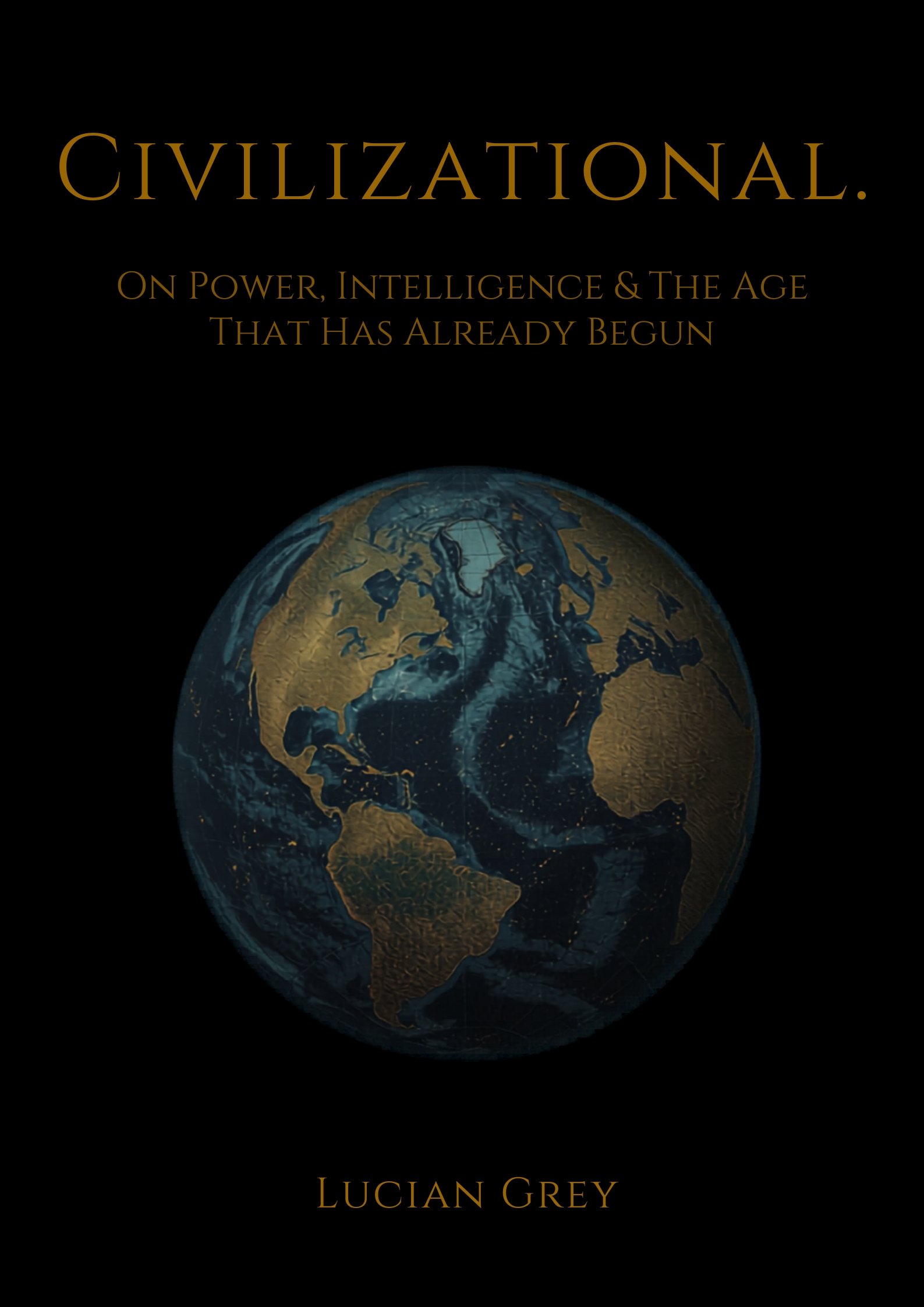
The Book
On Power, Intelligence, and the Age That Has Already Begun — a work about what happens when intelligence itself becomes infrastructure, and the institutions built to govern it are already too late.
Most leaders are asking how to adopt artificial intelligence. This book argues that is almost entirely beside the point.
The right question — the only one that will matter in twenty years — is what kind of civilization we are building, and who will govern it. Because that is what is actually happening. Not a technological transition. Not an industrial revolution in the familiar sense. Something older, stranger, and more total.
Across twelve chapters, Lucian Grey argues that treating AI as merely a powerful tool is a category error — one on which billions of dollars of investment and most of the world's AI strategy is quietly built. The book refuses to soften its conclusions, because comfort, in the presence of civilizational change, is not a virtue. It is a symptom.
01 — Infrastructure
AI not as novelty but as infrastructure: the first tool that does not extend the body but encroaches on the province of human judgment itself.
02 — Autonomy
The quiet transfer of judgment from individuals to systems optimized for prediction and engagement — and what it takes to remain the author of your own life.
03 — Power
Who owns the compute owns the era. On capital, the state that is structurally late, and the concentration of power that will define the coming decade.
“No one will figure it out in time if the people with the power to act choose the serenity of not knowing over the discomfort of understanding.”— Civilizational, Preface
Inside the Book
From the category error at the heart of AI strategy to the personal question of agency, the argument tightens chapter by chapter.
On why we keep calling this a technology.
Writing, print, electricity — and what history actually teaches us.
Tools that extend the body versus tools that extend the mind.
On capital, compute, and the new geography of power.
Governments, regulation, and the permanent disadvantage of institutions that move slowly.
Why the continent that invented democratic governance is losing the century's most important contest.
The difference between executives who adopted AI and those who grasped it.
What changes, what doesn't, and what most leadership theory gets completely wrong.
Corporate governance, fiduciary duty, and the institutional blindness that will define a decade of failure.
Nations, corporations, and the new question of who actually governs.
Agency, autonomy, and what it means to remain the author of your own life in a world of governing intelligence.
A final argument, without softening.
Read the Work
Available now in paperback. Read the book that treats you as an adult capable of confronting difficult ideas — without requiring them to be decorated.
Also available from selected booksellers
FAQ
What the book is, who it's for, and where to find it.
It argues that AI is not a technology but a civilizational transition — one reshaping power, institutions, and human agency. Instead of asking how to adopt AI, it asks what kind of civilization we are building, and who will govern it.
No. It requires no technical background. It is a book of argument about power, governance, and agency — written for leaders, policymakers, and anyone who wants to understand what the AI transition means rather than how the technology works.
The author of Civilizational. He writes on artificial intelligence, institutional decline, and the conditions that let human beings remain the authors of their own future.
Civilizational is available in paperback on Amazon and through selected booksellers worldwide. Use the buy links above to find the marketplace most convenient for you.